
The Sri Lankan Leopard The Complete 2026 Guide to the World's Most Accessible Big Cat
Everything you need to know about the Sri Lankan Leopard in 2026 biology, behaviour, conservation status, how to find one in Yala, what a sighting actually looks like, and why this is the most remarkable big cat encounter on Earth.
The Leopard That Should Not Be This Visible
Every experienced wildlife watcher knows the same frustration. Leopards are the most secretive of the big cats — masters of concealment, primarily nocturnal, and deeply reluctant to reveal themselves to anything resembling a human presence. In Africa, where they share the landscape with lions and hyenas, they have evolved a wariness bordering on paranoia. Experienced safari-goers spend weeks in the Serengeti or Kruger without a meaningful leopard encounter. When they finally see one, it is usually a distant glimpse — a spotted flank disappearing into long grass, a tail vanishing over a branch, a shadow where the tracks ended.
And then you go to Yala.
A female leopard lounges on a sun-warmed granite boulder at 6:30 AM, 25 metres from your stationary jeep, making full and sustained eye contact while she yawns. She is not hiding. She is not fleeing. She is, for all practical purposes, ignoring you with the casual authority of an animal that has never needed to be afraid of anything.
This is the Sri Lankan Leopard (Panthera pardus kotiya). It is the most visible, most studied, and most photographically accessible wild leopard population on Earth. Understanding why requires understanding the animal itself — its biology, its evolutionary history, its relationship with Yala's unique ecosystem, and the conservation crisis that threatens its survival even as tourists queue at the park gate to photograph it.
This guide covers all of it.
Part 1: The Biology of the Sri Lankan Leopard
A Distinct Subspecies — Not Just a Regional Variant
The Sri Lankan Leopard is not simply a leopard that happens to live on an island. It is a genetically distinct subspecies — Panthera pardus kotiya — formally described in 1956 by British zoologist Pocock, who recognised sufficient morphological differences from the Indian leopard (Panthera pardus fusca) to justify subspecific status. Subsequent genetic analysis has confirmed this distinction, placing the Sri Lankan Leopard in a separate evolutionary lineage that diverged from mainland leopard populations when Sri Lanka became an island approximately 12,000–15,000 years ago during the post-glacial sea level rise.
The isolation that followed — separated from mainland India by the Palk Strait — produced a population that evolved independently for thousands of generations. The result is an animal that is recognisably a leopard but distinctly, measurably different from its closest relatives.
The Size Advantage: The Largest Leopard in Asia
The Sri Lankan Leopard has evolved to become the largest leopard subspecies in Asia. Large males have been recorded reaching 77 kg (170 lb) and 1.42 metres in head-to-body length — substantially larger than Indian leopards of comparable age. The reason for this size evolution is straightforward: in Sri Lanka, the leopard faces no apex competition.
In India, leopards co-exist with tigers, lions (historically), and dholes (wild dogs) — all of which can displace or kill leopards and compete for prey. These competitors suppress leopard body size (smaller individuals can hide more effectively) and force leopards into primarily nocturnal behaviour (darkness provides cover from competition). In Sri Lanka, there are no tigers, no lions, and no dholes. The leopard is the island's uncontested apex predator. The evolutionary pressure to be small and secretive simply does not exist here. Individuals that grow larger can hunt larger prey, defend larger territories, and reproduce more successfully — and so Sri Lankan Leopards have evolved to be significantly bigger than their mainland counterparts.
The Sri Lankan leopard has possibly evolved to become a rather large leopard subspecies because it is the apex predator in the country.
Coat Pattern and Colouration
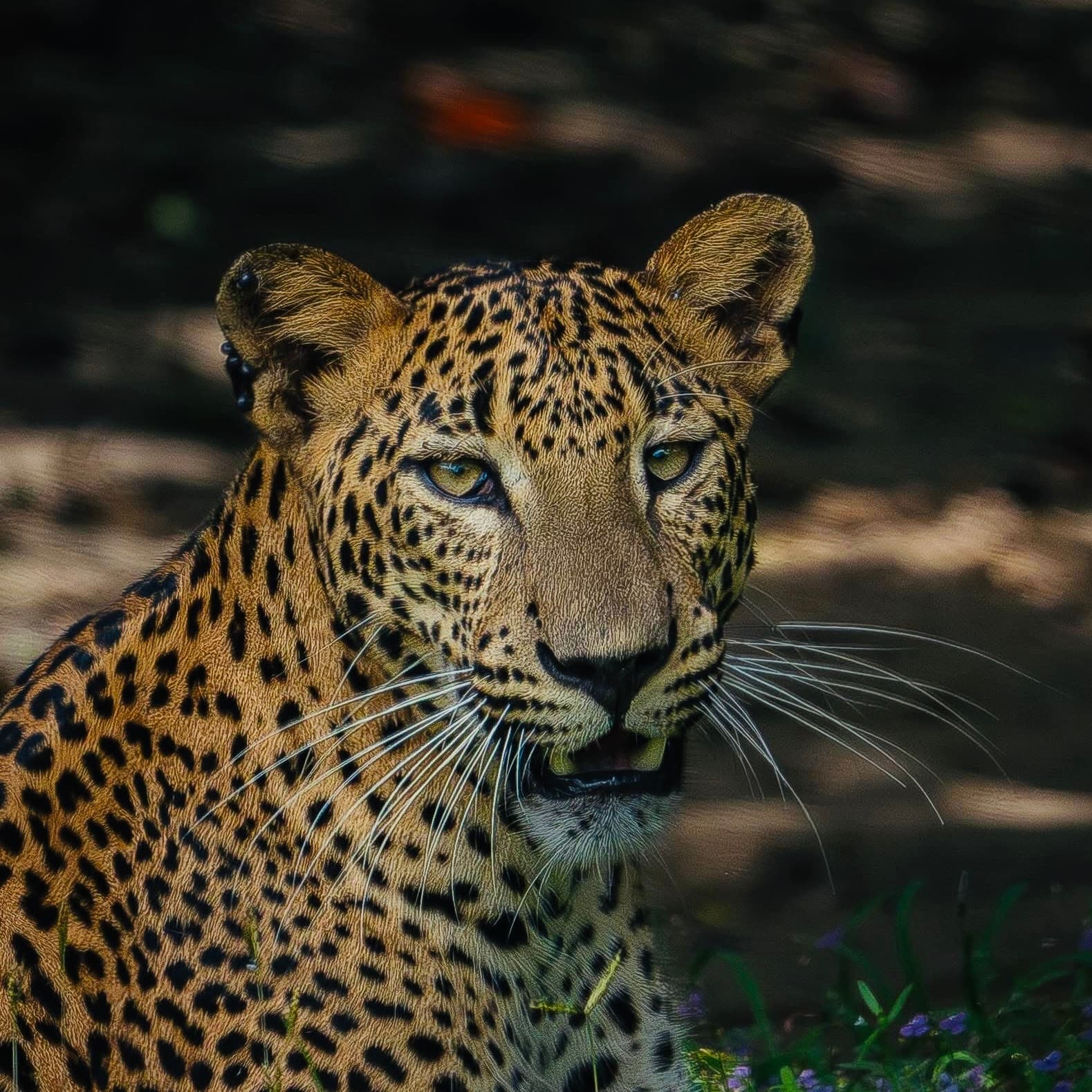
The Sri Lankan Leopard's coat is a warm golden-amber base overlaid with black rosettes — clusters of spots arranged in irregular circles with tawny centres. The pattern is unique to each individual, as distinctive as a human fingerprint, and is the basis of the photographic identification system used by researchers to catalogue and track individual animals.
In Yala's Block 1, researchers have identified and named over 150 individual leopards from photographic records accumulated over decades of systematic study. The catalogue includes multiple generations of known animals — mothers, cubs, territories, behavioural histories. When your guide tells you the name of the leopard you are looking at and describes her lineage, they are drawing on this extraordinary archive.
Melanistic leopards — the "black panther" colouration caused by a genetic mutation producing excess melanin — are documented in Sri Lanka but extremely rare. In October 2019, the Department of Wildlife Conservation recorded live footage of a melanistic individual for the first time, a male. No melanistic leopard has been reliably photographed in Yala's Block 1.
Sensory Capabilities
The Sri Lankan Leopard's sensory system is built for hunting in low light. Its eyes contain a tapetum lucidum — a reflective layer behind the retina that doubles the amount of light reaching the photoreceptors — giving it approximately six times greater night vision than a human. The vertical pupil contracts to a narrow slit in bright daylight to protect the retina, expanding to a near-complete circle in darkness to maximise light gathering.
Hearing is equally acute. The leopard's ears can rotate independently to triangulate sound sources, detecting the footfall of prey at distances exceeding 100 metres. This is why the silence your guide requests at a sighting is not performative — the leopard is genuinely hearing every conversation, camera motor, and shuffled foot at distances that feel impossible.
The whiskers — the vibrissae — extend to approximately the width of the body, allowing the leopard to navigate through dense vegetation in darkness without touching the sides of a gap. In Yala's dry scrub, where the leopard hunts at night, this tactile system guides movement through terrain that is impenetrable to human sight.
Part 2: Behaviour and Ecology in Yala
Territory and Social Structure
In Yala National Park, the Sri Lankan leopard is a solitary hunter, with the exception of females with young. Male's ranges typically overlap the smaller ranges of several females, as well as portions of the ranges of neighbouring males, although exclusive core areas are apparent.
In practical terms, this means that the leopards you encounter in Yala's Block 1 are not strangers to each other — they have overlapping territories, shared waterhole access, and complex social histories that the park's long-term researchers understand in considerable detail. A male encountered at a waterhole in the morning may have spent the previous night within 500 metres of the female whose territory overlaps his eastern boundary.
The territory sizes in Yala are notably smaller than in other leopard populations globally — a consequence of the park's extraordinary prey density. Spotted deer (Axis axis) occur at some of the highest densities of any deer population in Asia in Block 1. When prey is this abundant, leopards do not need large territories to sustain themselves, and the resulting compression of territories is precisely why Block 1's leopard density is so remarkable.
Hunting Strategy and Diet
The Sri Lankan Leopard is an opportunistic ambush hunter with a prey base dominated by spotted deer, supplemented by sambar deer, wild boar, grey langur monkeys, porcupines, and — occasionally — peacocks, mongoose, and smaller mammals. In Yala, the spotted deer is by far the most important prey species, providing the caloric foundation that supports the park's extraordinary leopard population density.
Unlike their African relatives, who routinely cache kills in trees to protect them from lions and hyenas, Sri Lankan Leopards rarely use the tree-caching strategy. They do not usually store their kills in trees, perhaps because similarly-sized or larger carnivores are absent in Sri Lanka. With no competition for carcasses, there is no selective pressure to expend the considerable energy required to haul a 40-kg deer carcass into a tree.
The hunt itself — which you almost certainly will not witness but should understand — involves a patient, ground-level stalk using the sparse dry-zone vegetation as cover. The leopard closes the distance to within 5–10 metres before launching a high-speed rush covering the remaining ground in approximately one second. The kill is almost always a throat bite — suffocation rather than the spine bite used by some other felids.
Activity Patterns: Why Yala's Leopards Are Different
They are more active and prefer hunting at night, but are also somewhat active during dawn, dusk, and daytime hours. This crepuscular and daytime activity pattern — so different from African leopards — is the defining characteristic that makes Yala the world's best location for leopard observation.
The reason is the absence of competing predators. In Africa, a leopard resting in the open during daylight is vulnerable to lions and spotted hyenas. In Yala, nothing threatens an adult leopard on the surface. The consequence of this security is that Yala's leopards will rest openly on granite inselbergs — the park's dramatic dome-shaped rock outcrops — in full daylight, sometimes for hours. They walk tracks at 7 AM with the unhurried confidence of animals that have never needed to be nervous about what might be watching.
This is the behaviour that produces the photographs. The relaxed, visible, unafraid daytime presence of Yala's leopards is not a product of habituation to vehicles alone (though that contributes) — it is the evolutionary consequence of thousands of generations without apex competition.
The Inselberg Phenomenon
Yala's granite inselbergs — ancient rounded rock outcrops rising from the dry scrub plain, warmed by the sun and offering 360-degree views of the surrounding landscape — are the leopard's preferred daytime resting sites. The thermal properties of the granite are perfect: cool enough in the pre-dawn to draw the cat out of the vegetation, warm enough by 7 AM to provide the body temperature maintenance that reduces the metabolic cost of thermoregulation.
The elevated position also serves a surveillance function. A leopard on an inselberg can monitor the movement of spotted deer herds across 300 metres of open plain while remaining invisible from ground level. This is where the majority of Yala's iconic leopard photographs are made — the cat horizontal on warm grey stone, tail curled, eyes half-closed in the early morning light, with the ocean visible in the background.
When you approach an inselberg and your driver slows before cutting the engine, this is why. The rock is worth looking at carefully and patiently before dismissing it as empty.
Part 3: The Individuals — Knowing the Leopards of Yala
One of the most remarkable aspects of Yala's leopard research programme is the depth of individual knowledge that has accumulated over decades of systematic photographic monitoring. What follows are the types of individuals you may encounter — categories derived from real research patterns in the park.
The Dominant Males
Adult male leopards in Block 1 establish and defend core territories centred on the highest-quality hunting grounds — the grassland-lagoon interfaces where spotted deer congregate in predictable numbers. These males are the most reliably photographed individuals in the park, as their territory cores overlap consistently with the areas that jeep drives traverse.
A fully mature male in prime condition is a genuinely imposing animal: long-bodied, heavy-shouldered, with a massive head and jowls that distinguish him immediately from females and younger males. When he walks a track, he does not deviate for jeeps. He is the most important animal in this ecosystem and he moves accordingly.
The Females with Cubs
Female leopards with young cubs represent the most emotionally resonant encounters in Yala. The cubs — born in concealed den sites within rock caves or dense thickets — begin accompanying their mother on hunts at approximately three months of age. From four to six months, they are increasingly visible on or near the inselbergs where the mother rests, playing, wrestling, and testing the granite edges with a boldness that the mother watches with magnificent apparent indifference.
A cub emerging from the bush into view alongside its mother — spotted, oversized-pawed, and furiously curious — produces a reaction from observers that is almost impossible to prepare for. The encounters that travellers describe most vividly, most passionately, and most tearfully when recounting their Yala visit are almost always cub encounters.
The Young Males
Sub-adult males — approximately 18 months to three years old — are the category most often involved in the high-visibility, relaxed daytime encounters that define the Yala experience. Having recently dispersed from their mothers but not yet established territories, these young males are exploratory, bold, and seemingly unbothered by jeep presence. Their territories are fluid; their tracks unpredictable; their encounters with jeeps often extended and leisurely.
Young males are also the individuals most likely to be photographed walking directly down tracks toward the jeep — not out of aggression but out of simple path-following. A young male who decides that the jeep is in his way will stop, assess you with apparent boredom, and then either walk around or continue directly toward you before veering off at the last moment.
Part 4: How to Find a Leopard in Yala — The Expert System
The Three Alarm Systems
Every experienced Yala guide uses a layered alarm-call monitoring system to locate leopards before radio networks alert other jeeps. Understanding this system transforms you from a passive passenger into an active participant in the search.
Layer 1 — The Sambar Bark: The sambar deer's single-note alarm bark is the highest-confidence leopard indicator in the park. A sambar that has identified a leopard at close range will bark repeatedly in the same direction, body tense, eyes fixed. When your driver's head snaps toward a sound you barely registered, this is often what they heard.
Layer 2 — The Spotted Deer Snort: A more common and less specific alarm — spotted deer snort at leopards, jackals, and large monitor lizards. But a herd of spotted deer that suddenly becomes alert, with all heads raised and all bodies oriented toward the same piece of scrub, narrows the options considerably.
Layer 3 — The Peacock Scream: The peacock's territorial call is a constant background feature of Yala's soundscape. The specific alarm scream — higher, more urgent, repeated — indicates a large predator in the immediate area. Your driver knows this distinction instinctively. You will learn it within an hour.
Layer 4 — The Langur Alarm: The grey langur's raucous, carrying alarm call indicates a large terrestrial predator below. Langurs in trees calling intensely toward a specific point on the ground beneath them frequently indicate a leopard moving through the forest floor beneath.
When all four layers activate in the same direction simultaneously, the leopard is almost certainly there.
The Radio Network
When a leopard is confirmed visually, drivers use radio to alert other jeeps — the system that produces the infamous "jeep jams" in Block 1. The ethics and logistics of this system are complex; what matters for your experience is understanding how to benefit from it without being consumed by it.
Being among the first three jeeps at a radio-alerted sighting produces a genuinely excellent encounter — you have time to position for light angle, watch the animal's behaviour, and photograph without the background noise of 40 engines. Being the 40th jeep produces the opposite.
The strategy: be at the gate at 5:15 AM. The first jeeps in the park are the first jeeps to radio sightings. The first jeeps to receive radio alerts are positioned closest to the sighting location. This compounding advantage of being early in the park is the single most reliable determinant of encounter quality.
The Waterhole Wait
The most patient and often most rewarding leopard-finding technique is the waterhole wait. In the dry season, as permanent water sources concentrate prey at predictable locations, leopards visit these waterholes to drink — typically between 5:30 AM and 8:00 AM when the temperature is still low enough for comfortable open-ground movement.
A driver who identifies a productive waterhole and cuts the engine, waiting in silence while other jeeps chase radio alerts, will frequently be rewarded with a leopard appearing from the tree line, drinking with the unhurried confidence of an apex predator, and departing without acknowledging that you exist.
This is not a passive experience. The silence of the wait — with the water surface still, the birds working the shallows, and the tree line examined yard by yard — is its own complete wildlife encounter. The leopard's arrival is the culmination of something that started building long before it appeared.
Part 5: What a Leopard Sighting Actually Looks Like
This section exists because almost no guide describes the actual phenomenology of the encounter — the sequence of events, the physical sensations, the specific behaviour that you will witness.
The Approach
You will rarely see the leopard before your driver does. The first signal is usually the engine cutting, which happens before your eyes have registered anything. Then the driver's arm extends, pointing at something that looks like rock, shadow, and scrub.
You raise the binoculars. You scan. Nothing.
Then something shifts — a flicker of rosette pattern that your brain assembles into form — and you see it. The leopard, horizontal on the rock, so perfectly integrated into the granite colour and texture that its outline was invisible until your visual cortex learned what to look for. The eyes are the final confirmation: amber, direct, and already watching you.
The Behaviour Sequence
At rest on an inselberg, a Yala leopard typically displays the following sequence over a 10–30 minute observation window:
Minutes 1–5: Motionless assessment. The leopard evaluates the jeep. If it has seen jeeps before (which all Block 1 adults have), this assessment is brief and non-anxious. The tail may flick once.
Minutes 5–15: Relaxation. The leopard looks away from the jeep — a significant behavioural indicator that it has classified the jeep as non-threatening. It may groom, shift position, close its eyes, or scan the surrounding landscape for prey.
Minutes 15–25: Activity. The most photographically productive window. The leopard rises to stretch — a full-body, back-arching extension that is one of the most beautiful single movements in the animal kingdom. It may yawn — revealing the full dental array at extremely close range, which produces involuntary gasps from every person in the jeep. It may descend from the rock, which triggers the most intense photographic activity of the observation as the full body becomes visible in motion.
The Departure: The leopard moves into the scrub with a fluidity that seems to violate physics. One moment it is entirely visible; the next it has simply become part of the landscape. The absence is as striking as the presence. The jeep remains stationary in silence for a full minute afterward, processing what just happened.
The Physical Experience
People who have seen leopards at Yala describe consistent physical responses that they did not anticipate: a sudden cold clarity of perception, a suppression of peripheral awareness as the visual system narrows entirely to the animal, a difficulty swallowing, and very frequently, silent tears that begin during the encounter and are not noticed until the leopard has gone.
This is not sentimentality. It is the recognition of something genuinely ancient — a relationship between the human nervous system and the large predator that existed for millions of years before it became a museum exhibit or a screen image. Seeing a wild leopard at close range in full light reactivates something in the brain that almost no other experience reaches.
Prepare for this. It will happen.
Part 6: The Conservation Crisis — The Truth That the Safari Industry Rarely Tells You
The most beautiful wildlife experience in Asia is occurring against the backdrop of a genuine conservation emergency. Understanding this context is part of being a responsible visitor to Yala.
The Population Reality
It has been confirmed that Yala National Park has the highest density of leopards to be found anywhere in the world — as much as one leopard per square kilometre. Though the prevalence of the Sri Lankan leopard population is high (300–350 leopards in total, of which 30–50 roam around Block I at Yala National Park), it still takes a well-trained eye to observe these elusive big cats in action.
Three hundred to 350 individuals sounds like a stable population. In the context of global leopard conservation, it is — Sri Lanka's leopard population is actually one of the more secure in the world for this species. But the distribution of that population is alarming: the majority are concentrated in a fragile network of protected areas, with increasingly small and isolated populations in the hill country estates and forest patches outside the parks.
The Threats
Habitat Loss and Fragmentation: Sri Lanka's leopard population outside protected areas faces severe and accelerating habitat fragmentation. The survival of the Sri Lankan leopard is primarily threatened by increasing habitat loss and fragmentation, together with an increasing risk of human-induced mortality. Tea and rubber estate expansion, village encroachment into wildlife corridors, and road construction through previously continuous forest all fragment the genetic connectivity between subpopulations.
Human-Induced Mortality: Leopards are killed by people either accidentally in wire snares set for other species, or as retaliation after livestock depredation — usually through poisoning the livestock carcass. Since 2010, over 90 leopards are known to have been killed by people in Sri Lanka. Ninety individual leopards in 15 years, in a total population of 300–350, represents a mortality rate that the population can barely sustain.
Safari Tourism Pressure: A guide sadly shook his head and said: "In 10 years it will be virtually impossible to see a leopard in Yala. We will have scared them all away." This assessment reflects a real concern. The park's extraordinary tourism growth — from 43,000 visitors in 2008 to over 650,000 by the mid-2010s and continuing to rise — places chronic stress on the leopard population even in the absence of direct mortality. Behavioural modification caused by persistent vehicle pressure is documented: animals that avoid certain areas during the day, that shift activity patterns to reduce jeep encounters, that abandon previously reliable resting sites when vehicle pressure becomes too intense.
The Conservation Work
The Wilderness and Wildlife Conservation Trust (WWCT), founded by researchers Anjali Watson and Andrew Kittle, leads the most comprehensive leopard research and conservation programme in Sri Lanka. The Leopard Project under the WWCT is working closely with the Government of Sri Lanka to ensure that conservation measures are targeted and effective.
The WWCT's long-term photographic identification database — covering decades of individual leopard monitoring — is the scientific foundation on which all meaningful management decisions about Yala's leopard population rest. Supporting this work, either through direct donation or through choosing ethical safari operators who contribute to conservation funds, is the most meaningful thing a Yala visitor can do beyond the safari itself.
What You Can Do
Your visit to Yala contributes directly to the economic case for leopard conservation. Tourism revenue generated by the park's leopard population is one of the most powerful arguments for its protection — demonstrating to policy-makers and local communities that a living leopard is worth more than a dead one.
But the quality of your visit also matters for the leopards themselves:
Never encourage your driver to approach closer than 30 metres. The 30-metre minimum distance exists to protect the leopard's stress levels, not to inconvenience photographers.
Never pressure your driver to follow a departing leopard into dense vegetation. A leopard that retreats from an open sighting is showing you its limit. Pursuing it extends the stress beyond what the observation justified.
Choose operators with documented ethical standards. Operators who maintain distances, refuse to follow fleeing animals, and actively educate clients about leopard behaviour are the ones whose business model supports rather than undermines the leopard population long-term.
Report violations. If your jeep driver, or a driver you witness, violates park regulations — driving off-track, approaching within 10 metres, chasing a fleeing animal — report this to the Department of Wildlife Conservation. The reporting system exists; it works when used.
Part 7: The Leopard Facts That Searchers Most Want to Know
How Many Leopards Are in Yala National Park?
The total Sri Lankan leopard population is estimated at 300–350 individuals across the island. Block 1 of Yala National Park contains an estimated 55–90 resident individuals depending on the survey methodology and year. The density in Block 1 — approximately 1 leopard per square kilometre in prime habitat areas — is the highest documented for any wild leopard population anywhere on Earth.
How Big Is a Sri Lankan Leopard?
Adult males weigh between 56–77 kg (123–170 lbs) and measure 1.27–1.42 metres in head-to-body length, with a tail adding a further 86–97 cm. Adult females are significantly smaller — typically 29–35 kg and 1.04–1.14 metres in body length. Large males have been suggested to reach almost 100 kg (220 lbs), but evidence for this is lacking.
What Is the Difference Between a Sri Lankan Leopard and an African Leopard?
The Sri Lankan Leopard (Panthera pardus kotiya) is larger, more visible, and diurnally active compared to African subspecies. It does not cache kills in trees. It shows significantly less wariness toward humans and vehicles. Its coat colouration is typically a richer golden-amber than the paler yellows common in arid-habitat African populations. Genetically, it represents an island-isolated lineage with thousands of years of independent evolution as an apex predator without competition.
Is the Sri Lankan Leopard Endangered?
The Sri Lankan Leopard is classified as Vulnerable on the IUCN Red List — one category below Endangered. The population is considered stable within protected areas but declining in the hill country outside protected zones. The primary threats are habitat fragmentation and human-induced mortality. The Yala population specifically is the most secure subpopulation on the island.
What Do Sri Lankan Leopards Eat?
The primary prey in Yala is spotted deer (Axis axis), supplemented by sambar deer, wild boar, grey langur, and various smaller mammals and birds. The diet is opportunistic — any prey within the leopard's size range is taken when available.
Do Sri Lankan Leopards Attack Humans?
Attacks on humans by Sri Lankan Leopards are extremely rare. The species shows a strong avoidance response to human presence outside the vehicle context of Yala's safari environment. The primary risk to humans comes from surprising a leopard at close range in dense vegetation — a scenario that does not occur on a standard jeep safari.
The Moment That Changes Everything
There is a specific moment — not the sighting itself, but the moment after it ends — that every person who has seen a wild leopard in Yala describes in almost identical terms.
The leopard has gone. The jeep is still. Your guide is watching the tree line where the animal disappeared. Nobody speaks. The recording on your camera shows 47 images in the last 4 minutes. The morning air still smells of dry scrub and dust.
And something has shifted. Not dramatically. Not in a way that makes itself immediately clear. But some part of your understanding of the natural world has been permanently revised — enlarged — by the fact of that animal, in that light, at that distance, existing in complete indifference to your presence.
This is what the Sri Lankan Leopard does to people who encounter it properly. It does not perform. It does not respond to your schedule. It simply exists — the largest leopard in Asia, the apex predator of a paradise island, the animal that has been here for longer than human history — and for a few minutes, it allowed you to exist alongside it.
That is enough. That is everything.
Last updated: May 2026 | Biological data, population estimates, and conservation information sourced from published scientific literature, IUCN Red List assessments, WWCT research publications, and verified field accounts from Yala National Park, Sri Lanka.
Ready to see this in real life?
Book your Yala safari today and experience the magic firsthand.
Explore Packages